Your First Rupee Playbook
How Indian micro-creators can build their first scalable income stream without relying on massive audience metrics.
Earning With Under 5,000 Followers
The most damaging myth in the creator economy is the belief that you need 100,000 followers to start making a living. Creators often postpone monetization, waiting for a magical subscriber milestone that guarantees brand deals.
The reality of the modern digital economy is entirely different. If you have 1,000 highly engaged followers who deeply trust your specific expertise, you do not just have an audience—you have a highly targeted, lucrative business. Your first rupee won’t come from a multinational brand sponsorship; it will come directly from the community you’ve cultivated.
1. Shift Your Mindset: Targeted Trumps Broad
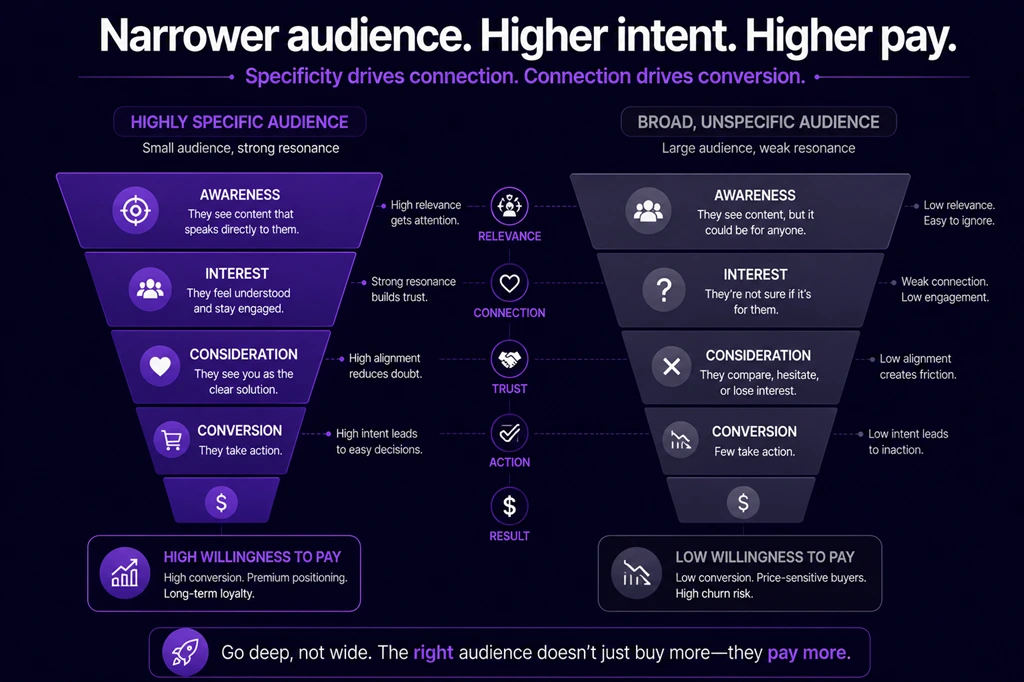
Monetization potential scales with specificity, not just volume.
If your content revolves around general, broad-appeal comedy, 1,000 followers will not generate meaningful income. The audience is there for a quick laugh and will rarely convert into paying customers.
However, if your content is relentlessly focused on a specific pain point—such as “Advanced Excel automation formulas for Indian CA students” or “Setting up headless architectures for freelance developers”—those 1,000 followers represent a concentrated pool of high-intent buyers. They are actively looking for solutions that save them time or make them money, and they are willing to pay a premium for it.
2. Low-Friction Digital Products
Your first product should not be a massive, ₹10,000 masterclass that takes you three months to record and edit. The goal of your first product is simply to break the “free content” barrier and prove to yourself that your audience will pull out their wallets.
Build something highly actionable that you can create this weekend and sell for ₹99 to ₹499. The delivery should be entirely automated, allowing you to generate revenue asynchronously.
Ideal First Products:
- The Blueprint/Template: A structured Notion workspace, a budgeting spreadsheet, or a pre-configured automation workflow. You are selling the time you saved them by doing the setup yourself.
- The Curated Directory: A heavily researched database of tools, vetted manufacturer contacts, or high-converting prompt libraries tailored to your specific industry.
- The Actionable Mini-Guide: A concise, 10-page PDF detailing exactly how to solve one specific, recurring problem your audience faces.
3. The 1-on-1 Consulting Model
If you possess a hard technical or creative skill—such as UI/UX design, video editing, cloud infrastructure setup, or financial planning—your social media feed is essentially a public portfolio.
Instead of waiting for clients to discover you on crowded freelance marketplaces, utilize your platform to drive direct consultations.
- The Setup: Add a direct booking link to your bio labeled “Book a 30-Min Strategy Call.”
- The Infrastructure: Utilize platforms integrated within the Growwh ecosystem or standalone scheduling tools that handle calendar syncing, video conferencing links, and upfront UPI/Stripe payments simultaneously.
- The Pricing: Do not underprice your time. Charge a premium for direct, uninterrupted access to your brain and custom solutions.
4. The 3-Day Launch Sequence
The biggest mistake creators make when releasing their first product is simply dropping a link on a Tuesday and hoping for the best. To drive conversions with a small audience, you must engineer a logical, psychological journey.
Execute this simple, high-converting 3-day launch sequence across your primary platform:
- Day 1 (The Problem): Post a piece of content highlighting the exact pain point your product solves. Agitate the problem. Let your audience voice their frustrations in the comments. Do not mention your product yet.
- Day 2 (The Proof): Share a case study or a behind-the-scenes look at how you successfully bypassed that exact pain point. Show the result. Build the desire for the solution.
- Day 3 (The Solution): Announce your digital product or consulting slots. Explicitly state who it is for, what transformation it provides, and drop the link.
By leading with value and framing your product as the ultimate operational shortcut, your micro-community will convert at a significantly higher rate than massive, untargeted audiences.
Get paid monthly. Free to join.