The Weekly Idea Engine
Move from guessing what to post to answering exactly what your audience is actively searching for using data-driven ideation systems.
Mining Search Data and Comments
The biggest bottleneck for creators isn’t filming or editing; it’s staring at a blank page. Relying on spontaneous inspiration is a fast track to inconsistent posting and creator burnout.
To build a sustainable content pipeline, you need a systemic engine that generates ideas automatically based on data, not inspiration. By shifting your mindset from “What do I want to say?” to “What is my audience actively asking for?”, you guarantee high relevancy and organic search velocity.
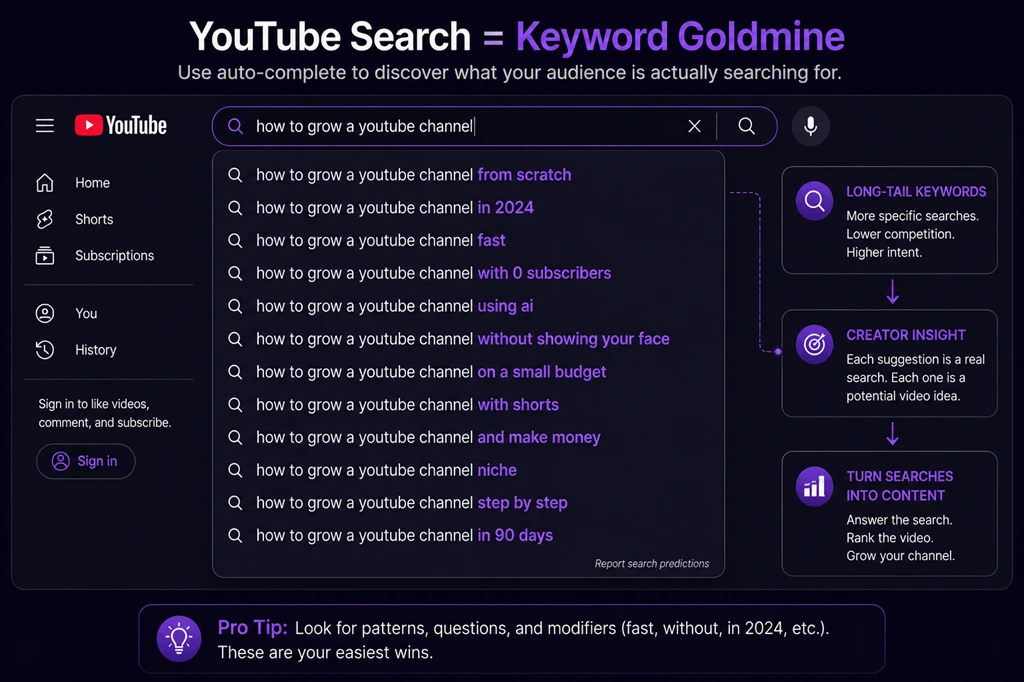
1. Mining YouTube Auto-Complete (The Intent Engine)
YouTube is the second largest search engine in the world. It processes billions of queries, making its search bar the most accurate representation of audience intent available on the internet.
Here is the exact workflow to extract these ideas:
- Step 1: Go to YouTube incognito. This is crucial because your personal viewing history skews the algorithm. You need raw, unbiased search data.
- Step 2: Type your niche plus a modifier (e.g., “React Native for…”). Do not hit enter. Just let the dropdown menu populate.
- Step 3: Harvest the Data. The auto-complete suggestions are literal data points of what thousands of people are currently searching for. Write them down.
Each of these suggestions represents a highly searched, long-tail keyword. Because the audience is explicitly typing these queries, any content you create answering these exact phrases will naturally index higher in search results.
2. Scraping Competitor Comments (The Gap Analysis)
Your competitors have already done the hard work of gathering your target audience into one place. Your job is to find the gaps in their content delivery.
- Identify the Targets: Find 5 creators in your niche who are slightly larger than you.
- Audit the Archive: Go to their most popular videos.
- Filter for Friction: Sort comments by “Newest” or look for high-reply threads. You are not looking for praise; you are looking for confusion.
- Extract the Objections: Look for the “Yes, but…” comments (e.g., “Great video, but how does this apply to Indian tax laws?”).
When a viewer asks a clarifying question that the original creator ignored, they have handed you a validated content idea on a silver platter. That gap is your next video.
3. The “Two-Word” Google Trends Method
Trendjacking is highly effective if you catch a topic on the upward slope. Use Google Trends (filtered to India) to spot these waves before they peak.
- The Setup: Compare two broad topics in your niche (e.g., “Mutual Funds” vs “Fixed Deposits”). Set the timeframe to the last 30 or 90 days to ensure recency.
- The Extraction: Scroll past the geographical maps and look at the “Related Queries” section at the bottom. Ensure the sorting is set to “Rising”.
- The Execution: These are rising breakout topics. They represent sudden spikes in public interest, often driven by recent news or viral events. Build content around those rising queries before they hit mainstream saturation.
4. Centralizing the Idea Backlog
Once you gather these search queries and comment gaps, you need a structured place to put them. Instead of fragmenting your workflow across random note-taking apps on your phone or laptop, log these raw ideas directly into your Growwh workspace.
Keeping your ideation, scripting, and broader creator ecosystem unified in one dedicated platform prevents valuable data from falling through the cracks. Set up a simple Kanban board within your ecosystem with three columns: Raw Ideas, Validating Data, and Ready for Scripting.
When you sit down to plan your week, you simply pull a validated idea from the board and start executing.
Get paid monthly. Free to join.