Earn Beyond the Feed
A comprehensive guide to transitioning your audience from free public content to paid, scalable, and secure learning communities.
Building High-Ticket Communities & Cohorts
Content gets people in the door. Community keeps them in the house.
For the first few years of your creator journey, your primary focus is audience acquisition. You optimize for the algorithm, chase reach, and build top-of-funnel awareness. However, the ultimate evolution of a creator business is not gathering more fleeting views; it is building a fortified, private space where your most dedicated audience members learn not just from you, but from each other.
Transitioning your top 1% of followers into a high-ticket, owned community is the most reliable path to generating Monthly Recurring Revenue (MRR) and breaking free from the algorithmic treadmill.
1. The Death of the Passive Course vs. The Rise of Cohorts
The traditional creator monetization playbook used to be simple: record a 5-hour video course, price it at ₹499, and try to sell as many copies as possible.
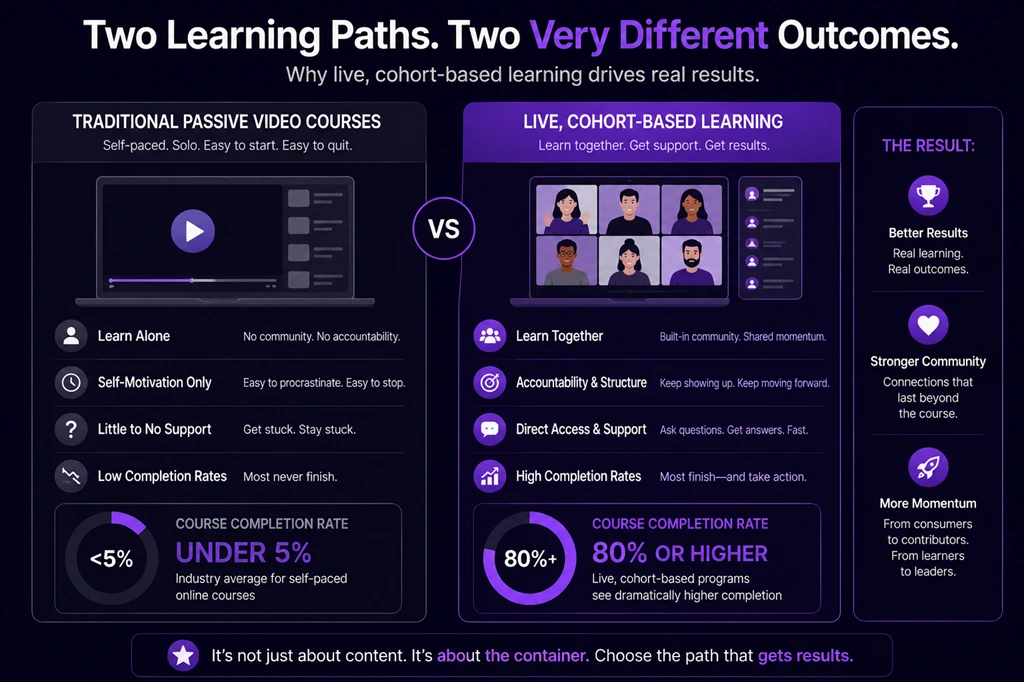
The problem? Passive video courses have an industry-wide completion rate of under 5%. People buy them for the dopamine hit of feeling productive, but they rarely execute the material. Because they don’t execute, they don’t get results. Because they don’t get results, they never buy from you again.
Instead of selling low-ticket, pre-recorded information, modern creators are scaling through High-Ticket Live Cohorts. Instead of a ₹499 passive course, you sell a ₹4,999 four-week interactive bootcamp.
Why this model wins:
- Accountability: Live weekly Zoom sessions and structured homework assignments force completion.
- Networking: Students are initially drawn to the community to access your brain, but they end up staying for the high-caliber peers they meet inside.
- Transformation Over Information: You are no longer selling “how to code”; you are selling a specific outcome, like “Launch your first Website-as-a-Service in 30 days.”
2. Architecting Your Private Ecosystem
To justify a premium price point, your community cannot live entirely in a disorganized WhatsApp or Telegram group. The noise-to-signal ratio on those chat apps is too high, and they lack the infrastructure to host organized curriculum.
You need a centralized digital storefront or a dedicated creator application environment that seamlessly integrates three core pillars:
- The Content Hub (LMS): A secure, structured library where your video lessons, Notion templates, and raw code repositories live. This must be easily navigable so members can reference past materials without getting lost.
- The Communication Layer: Dedicated chat channels broken down by specific topics (e.g., #general, #feedback-requests, #wins, #technical-support).
- The Event Calendar: A built-in schedule for your weekly live Q&A calls, guest expert workshops, or collaborative co-working sessions.
3. The 4-Phase Waitlist Launch Strategy
You should never build a massive curriculum in silence and launch it cold. A successful community launch is fundamentally an exercise in psychology and anticipation.
Follow this strict 4-phase launch sequence to maximize your conversion rates:
Phase 1: The Tease (Weeks 1-2)
Start casually mentioning the project on your main feeds. Show behind-the-scenes screenshots of you outlining the curriculum or setting up the community infrastructure.
- Hook: “I’m tired of seeing freelance developers struggle with client acquisition. I’m building a system to fix it. More details soon.”
Phase 2: The Capture (Week 3)
Do not reveal the price yet. Drive all your social media traffic to a simple landing page that captures email addresses. This is your “Waitlist.”
- Hook: “The curriculum is almost ready. I’m only taking 50 students for the beta cohort. Join the waitlist here to get 24-hour early access before I announce it publicly.”
Phase 3: The Nurture (Week 4)
Send 3 to 4 emails to your waitlist. Share your personal story, detail exactly what the 30-day transformation will look like, and share case studies or testimonials if you have them.
Phase 4: The FOMO Launch (Launch Day)
Open the doors to the waitlist 24 hours before you mention it on Instagram or YouTube. Offer the waitlist a slight discount or an exclusive bonus (like a 1-on-1 onboarding call). Because you capped the seats (e.g., 50 spots), the scarcity will drive immediate action.
4. Retention: Preventing the Churn
If you are running a recurring monthly membership instead of a one-time cohort, your biggest enemy is churn (members canceling their subscriptions).
To keep MRR stable, you must engineer regular “wins” for your community:
- Weekly Rituals: Host a “Wins of the Week” thread every Friday where members brag about their progress.
- Member Spotlights: Elevate your best students. Interview them on a live call so others can learn from their execution.
- Direct Access: Host “Hot Seat” sessions where one member volunteers to have their specific business problem aggressively workshopped by you and the rest of the community.
By focusing on transformation and peer-to-peer connection, you shift your business model from constantly hunting for new followers to deeply serving the ones you already have.
Get paid monthly. Free to join.