The Audience Feedback Loop
An operational blueprint for engineering audience loop systems, mining comments for high-relevance content, and scaling personal trust in the DMs.
Turning DMs & Saves into a Growth Engine
Views are an unstable metric. If your creator toolkit relies entirely on top-of-funnel impression spikes, your business is perpetually vulnerable to the next algorithmic adjustment. True, scalable growth happens when you design systems that transform passive, distracted scrollers into active community participants.
To scale predictably, you must treat your audience not as a broadcast audience, but as a real-time decentralized research and development department. By building a closed loop where audience interaction directly dictates your content output, you eliminate creative guesswork and train platform algorithms to favor your distribution.
1. The True Algorithmic Hierarchy
Social algorithms have moved past basic vanity indicators. A “Like” requires minimal friction—a user can double-tap a screen mechanically without digesting a single second of your message. Modern content distribution systems weigh actions based on user intent and psychological investment.
To maximize organic reach, your scripts and visual hooks must be engineered specifically for the two highest-value interactions:
The Utility Metric: Saves
A Save is an explicit statement of future intent. When a user saves your video or post, they are telling the algorithm: “This information is so technically dense, practical, or critical that I need to store it in my personal archive to reference later.” Platforms reward this heavily because it signals deep utility, keeping users anchored to the application.
The Identity Metric: Shares
A Share is a declaration of personal identity. When someone forwards your content to a colleague or posts it to a private group, they are saying: “This video perfectly articulates my perspective, solves a problem my peers are facing, or makes me look informed by association.” This drives authentic, compounding network effects completely independent of cold algorithmic curation.
2. The Comment Mining Framework (The Friction Map)
Stop reading your comment section just to look for praise. Your comment section is a continuous, free goldmine of market data detailing the exact execution bottlenecks your target demographic is experiencing.
To turn comments into a repeatable content-generation engine, execute this structured audit every 7 days:
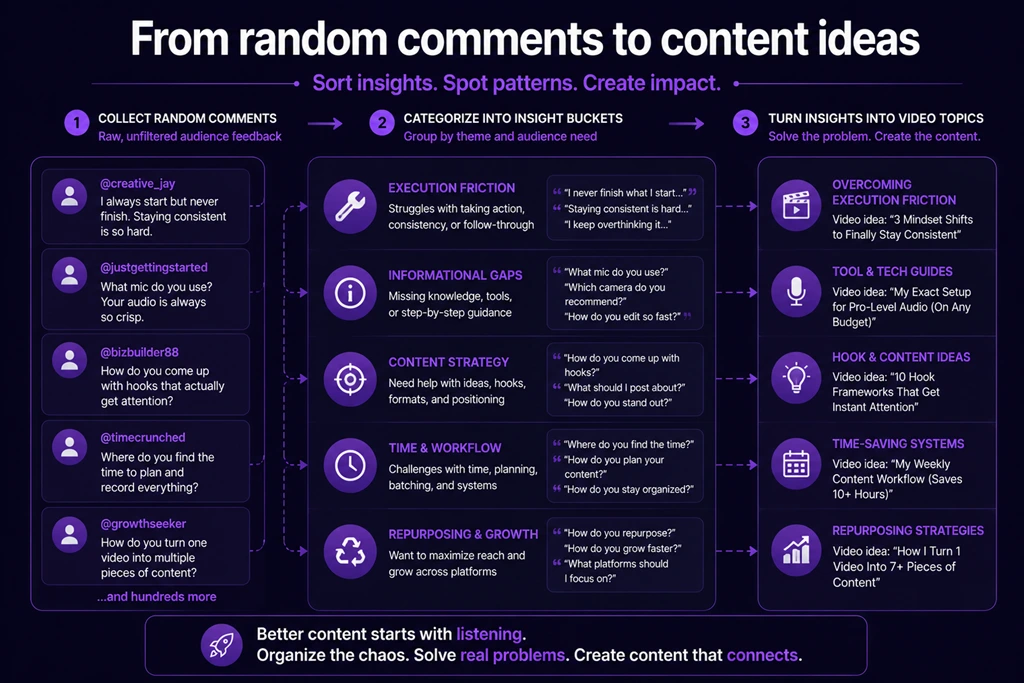
Step 1: Categorize Inbound Feedback
Review the comments across your last 5 pieces of content, as well as the comment feeds of 3 major competitors in your space. Filter every user interaction into one of three distinct diagnostic buckets:
- Execution Friction: “I tried setting up the Docker container on my local machine like you showed, but I keep hitting an out-of-memory error.”
- Contextual Skepticism: “This works great if you are building for a US target market, but how does this handle local UPI compliance and low-bandwidth connectivity in Tier-3 Indian cities?”
- Informational Gaps: “What happens to the data persistence layer if the managed backend service scales past its free tier limits?”
Step 2: The “Comment-to-Short” Production Pipeline
Do not reply to high-value friction points with static text answers. Treat them as individual video prompts.
- Screenshot the specific, high-friction user comment.
- Begin your next short-form video or post by placing that screenshot directly on the screen as the initial visual hook.
- Your script wrapper should immediately answer the question without fluff: “If you are running into this exact error while deploying your infrastructure, here is the 3-line configuration fix you need to apply right now.”
This system guarantees that 100% of your technical output is pre-validated by actual user demand, establishing you as an accessible, solution-oriented authority.
3. Scaling Trust via Direct Messages
The main feed is your marketing billboard; the Direct Messages (DMs) are your business consultation room. If a follower takes the initiative to send you a private message, they have cleared a significant barrier of intent.
To manage high inbound message volumes while maintaining a deep, un-automated sense of personalization, use the Asynchronous Voice Note Funnel:
The 3-Step Voice Note Framework
When a viewer messages you asking for specific advice or troubleshooting help, avoid typing a dense wall of text. Send a 30-to-45-second audio message instead. Hearing an authentic human voice immediately shatters the digital barrier, building rapid psychological proximity and converting a casual follower into an intensely loyal advocate. Structure the audio message using this sequence:
- The Personal Validation: Acknowledge them directly by their name. “Hey Rohan, appreciate you reaching out after watching the latest deployment video.”
- The Concise Solution: Offer one immediate, high-yield action step they can execute right now. “For that specific database synchronization lag, you need to check if your connection pooling parameters are saturating your CPU ceiling.”
- The Structured Loop: End with a clear, low-friction prompt that encourages continued engagement. “Try adjusting that limit to 20 connections today, and drop me a message here tomorrow to let me know if your latency drops.”
4. Designing the Conversion Bridge
Every major social network is a rented space. You do not own your distribution channels; you are entirely subject to changes in platform guidelines, monetization terms, and algorithmic reach filters. The ultimate objective of your audience feedback loop is to build a reliable bridge routing users off public algorithmic platforms into an owned, interactive community structure.
Setting Up the Lead Magnet
Convert your high-performing “Saved” content into a structured digital asset—such as a configuration template, a localized pricing calculator, or an architectural checklist.
The Automation Sequence
Use conversational triggers on your public feeds. Instruct your viewers: “Comment the word ‘DEPLOY’ below, and I will instantly DM you the complete repository link and setup guide.”
This automates the top-of-funnel distribution, shifts the user interaction into the private intimacy of the DMs, and provides a direct, contextual path to invite them into a structured, dedicated ecosystem where they can communicate regularly, collaborate on projects, and eventually purchase your high-ticket products or services.
Get paid monthly. Free to join.